The next day, we readied ourselves for the crossing to Scotland with a short ceremony at Corrymeela, a humble Christian center for Irish reconciliation perched high on the cliffs overlooking the sea near Ballycastle. The center was a sister to the Iona community, and held a special place in the hearts of all Colmcille crew. Many of the Irish crew were linked with the center in some way, and the ’97 voyage of the Colmcille had been largely inspired by Corrymeela’s work for peace in Ireland. Even the cross we carried with us had been made from the rafters of the building.

It was fitting that here we would re-create a 6th century monk’s processional for the first time, dressed up in robes which had been made for our journey. Given the tensions of the parade we had witnessed in Portrush the day before, our recreation was now something more: a call for peace through Christian love and a physical reminder to those present of nobler, happier times. Donning the robes, however, was a difficult proposition: we were not monks, but wanted to recreate the voyage for those watching as well as possible. We debated a range of questions. “How do you fasten this thing?!?” Emmanuel exclaimed. John McDonald and I debated the best knot to use for the rope belt. We all wanted to know if we should walk with our hoods on or off. It was a sunny, breezy day and we did not wish to overexpose ourselves to the elements. Besides, some of us felt like dorks. In the end, each of us answered these questions on his own, and our ramshackle band of monks loped along in twos from the parking lot to the center. Poised behind the great wooden cross held aloft proudly by Donald, Alastair led us in chants as we processed. Hit by the sea views and the sound of our own voices as we entered the center, we began to feel more comfortable. We actually sounded pretty good! Even if we still looked like dorks.

Once inside, we were amazed at the number of people who had ventured there to see us off. The Crois, or inner sanctum of the center (from the Irish Gaelic for “little heart”), was full of assembled friends, family, past crew members. We were even humbled to see a few of the individuals we had met in the pubs of Portrush the night before.

We pushed off at 4:30 to a rousing dockside send off from the crowd. We pulled strongly out of the harbor as a crew, paying careful attention to the timing of our strokes. “Look good, boys, remember we have an audience,” Robin intoned. The weather was perfect, with a bright sun and a light breeze. In almost no time, we were in the channel between Rathlin Island and the Antrim coast,

pulling in unison as the sharp cliffs of Fairhead slid past us to the southeast. Razorbills flew overhead and skimmed the water to our port side, and the deep blue water was occasionally rippled by a curious seal poking its head above the surface to investigate our strange craft crabbing its way across the water. Once parallel with Rathlin, the winds moved to our Southwest, and we were able to set our sails which, combined with our rowing, allowed us to hit a fairly consistent speed of about 4.5 knots for several hours. The effect on the crew was euphoric, and with the hazy cliffs of the Mull of Kintyre closing on us to Northeast, Donald began to lead the crew in rowing songs.

Pulling as we sang, we made our way across the channel and into the North Channel between Islay and Kintyre, alternating breaks from the oars and passing around food. In keeping with the spirit of recreating Columba’s voyage, we restricted ourselves for the most part to 6th century foods: dried fruit, nuts, smoked fish, bread, and water. We laughed and joked as we tossed food to one another from the stern. Unable to take a break from rowing, I made a sandwich out of smoked mackerel and wholegrain bread, setting it on the bench beside me and grabbing a one handed bite when I could.
John Logan began tossing oranges to the crew.
“Would you like an orange, Tony?,” John asked.
“No thanks,” I replied, squinting in the sun. “I have a fish sandwich..”
He continued tossing them toward the back, when suddenly a chaos of clanking oars ensued on both sides of the boat as Ern and Alastair reached out to catch the same orange, sending it bouncing among their neighboring crewmen.
“Such chaos from a simple orange!” John said, looking at me with a twinkle in his eye. “I know!” I exclaimed, waving my mackerel sandwich high, “That’s why I had a fish sandwich!!”
Our spirits were further lifted when we experienced our first miracle. Searching under some bags at the bottom of the boat, Emmanuel discovered a case of “mead”—in bright red cans with a white stripe and c-o-c-a c-o-l-a down the side-- and began to pass them around. As we gulped the sugary liquid down, the brilliant green cliffs of Ireland began to fade away. We could now barely make out the smoky form of our destination, Gigha, on the horizon.
Our destination was actually the cause of some controversy among our crew. The itinerary clashed with what was actually possible with our mode of travel. Our originally planned destination was South End in Kintyre, the possible site of Columba’s first landing in Scotland (it is equally probable that he landed further up the Kintyre coast; no one knows for certain.) The weather, however, was not going to cooperate. The forecasts called for winds growing from a mild Force 1 to a respectable Force 3 out of the Southwest by morning. Those winds would lash the rocky shores of South End for several days. A landing at South End might be possible if we made it there before the winds had an opportunity to build in strength and alter the sea state, but this was unlikely given the time and our speed. Most likely, we would arrive at South End’s dagger-like coastline after the wind had churned up the surf enough to make a landing highly treacherous for crew and boat alike. Our landing would be fraught with peril as the wind powered surf battered the shore harder with each intensifying gust. This was bad enough, but the deciding factor was the extended forecast for the next few days: storm and Force 7 gusts out of the East. These winds would hit South End head on. Even if we were able to land, we would be unable to leave South End in those conditions. Assuming we ignored the sheer danger of such an attempt, we would still have to row our 4 ton boat directly into the raging surf against a 35 knot wind to get away from the rock strewn coast. This feat was simply not possible, and the resultant need to wait out the storm would throw the rest of our schedule in jeopardy. To many of us, the debate over landing at Gigha instead of South End underscored the challenges of trying to adhere to a 21st century timetable while traveling according to 6th century methods. Given our mode of travel, it was clear we would be beholden to the winds and the tides. While this would make keeping our modern schedule more difficult, it also underscored the challenges Columba would have faced on his original journey. Most of us felt this brought us closer to the spirit of our voyage as a result.

Around 11 pm the sun began to set behind the mountains on Islay, a salmon sky behind purple mountains over a sea of flame. Now in the protection of the Sound, the winds had died just prior to sundown, so we struck our sails. We rowed on as the twilight passed into half-light, with the Mull of Kintyre to our East, Islay and Jura to our West, Gigha slowly coming into view ahead. As darkness fell, these land masses on our horizon turned black, with the cobalt sky above subtly undulating to darkness over a silver moonlit sea.

By 2 AM, we had been rowing for almost ten hours, and the fatigue was beginning to wear on our crew. Our oars clashed regularly as we struggled to pull the boat the last few miles to port in Gigha. Passing Cara Island, a cliff faced island just to the south of Gigha, the exhaustion had reached the point where a few of us nodded off at the oars. Onward we pulled as the long shape of Gigha slid past us to port, wishing to a man that the harbor of Gigha’s main town of Ardminish was located on the southern end of the island. Finally, with the northern dawn beginning to rise over the horizon , the iron jetty came into view, and revitalized, our crew pulled the final half mile into port. We tied up to the jetty, and unloading our gear for the night, stepped ashore onto Gigha.
Gigha comes alive at dawn. At least the island itself does. Even as we were entering the harbor, we could hear the Dawn Chorus of birds singing in the half light. Now, as John Martin led us to the quarters where we would spend the night, the birdsong was overpowering. Birds were everywhere in the bracken, in the bushes, in the hedgerows. John guided us along a path through the fields, silent figures in the mist, awestruck as the Island raised its voice to greet us. Gazing out across the mist shrouded fields, the nighttime chill still in the air, with the sunrise just beginning to turn the villager’s stone cottages to salmon and purple, we were awestruck. Turning down the main lane of the
island, gravel crunching under our feet, we watched as the mist began to turn salmon as
well, and we were struck by the smell of flowers coming from what seemed to be every
bush. We arrived at John’s house just south of Ardminish in silent appreciation.
In Gaelic, Gigha means “God’s Isle.” Laying our heads down in John’s house after our long journey north, we began to understand why.
 There we planted some oaks from Ireland. Columba was fond of oak trees. It was our way of exhibiting how small things can grew into something big. Our prayer was for our small expedition to have a big impact on the faith of the people we met.

 Outside the Abbey after the service.


 It was dark when we reached IONA. We'd left Easdale Island early that Sunday morning with a prayer to speed us on our way, but winds and waves had held us up. The thirty nautical miles to the Holy Island had been long and hard. Our hands were red and blistered from hours of rowing. We were tired and a little hungry.
 Late afternoon we'd moored at the south end of the Isle of Mull, close to Malcolm's Point. We'd rested, as the currach pitched and rolled in the waves, which now were against us. It was lonely out there, looking up to the high crags of Mull, watching eagles soar and wheel in the updrafts.
 Thankfully we boiled potatoes on our small Coleman stove; a bakers dozen of men from the US, Scotland and Ireland; all together for this, our mission of Saint Columba. We ate the potatoes and some smoked mackeral, bread and cheese, then washed it down with red wine. A repast for a king, which Columba was, but a simple repast, for simple men of God, giving thanks for this 6th century food.
 The dark outline of IONA loomed ahead as we rowed towards it in silence. Then about 400 yards from the pier, a small motor boat approached us in the gloom. In the bow was a beautiful raven haired young woman, who waved at us as they passed, "Welcome to IONA" she shouted, with a smile and a wave. This was our "IONA welcome!" They circled around us, and led us into the dark jetty.
 It was now around 10:30pm and we had been at sea for 13 hours. Surely, I thought, we'd have a few people to greet us! My wife, and a couple of other friends. It would be nice to rest up in the village hall. Suddenly my tired thoughts were shattered, as a cry went up from the pier! We had been sighted, and a hundred voices rose in greeting. "Hip! Hip! Hooray!" Cries of welcome rose to the heavens as the currach slid into its final destination alongside the dark slip.


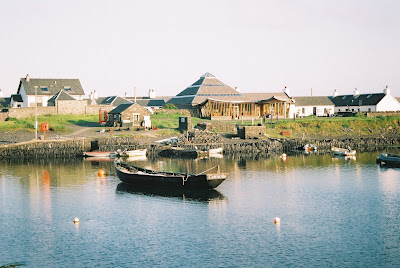
 There were wheelbarrows by the ferry house that the locals used to transport their purchases from the mainland back to their homes. John gives Robin a lift above in one of them.

 Several local churches participated in the worship service. Afterwards we took folks out on the Colmcille which was a great hit.


 We were able to visit Kilmartin and Lochgilphead. I learned about the Kingdom of Dalriada and its link to Ireland.